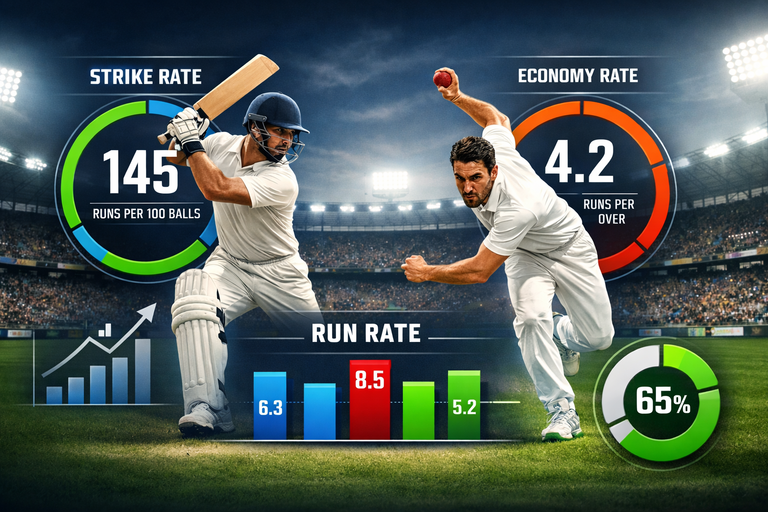
In modern cricket, statistics play a crucial role in understanding player performance and match situations. Among the most important cricket statistics are Strike Rate, Economy Rate, and Run Rate. These numbers help fans, analysts, and teams judge batting speed, bowling efficiency, and overall scoring pace in different formats of cricket.
Strike Rate, Economy Rate & Run Rate Explained
- Strike Rate measures how fast a batter scores runs
- Economy Rate shows how many runs a bowler concedes per over
- Run Rate indicates how quickly a team is scoring runs in a match
Together, these stats provide a clear picture of how a game is progressing.
What Is Strike Rate in Cricket?
Strike Rate is a batting statistic that shows how quickly a batter scores runs.
Strike Rate Formula
Strike Rate = (Runs ÷ Balls Faced) × 100
Example
If a batter scores 50 runs from 25 balls, the strike rate is:
(50 ÷ 25) × 100 = 200
A higher strike rate means the batter is scoring faster, which is especially important in T20 and ODI cricket.
What Is Economy Rate?
Economy Rate is a bowling statistic that measures how many runs a bowler gives away per over.
Economy Rate Formula
Economy = Runs Conceded ÷ Overs Bowled
Bowler Example
If a bowler concedes 24 runs in 4 overs, the economy rate is:
24 ÷ 4 = 6.00
A lower economy rate indicates better bowling control and efficiency.
What Is Run Rate?
Run Rate shows how fast a team is scoring runs during an innings.
Run Rate Formula
Run Rate = Total Runs ÷ Total Overs
For example, if a team scores 180 runs in 20 overs, the run rate is 9 runs per over.
Run rate is especially important when teams are chasing a target or playing under DLS method conditions.
Difference Between Strike Rate, Economy & Run Rate
- Strike Rate → Batters (scoring speed)
- Economy Rate → Bowlers (runs conceded per over)
- Run Rate → Team (overall scoring pace)
Each statistic focuses on a different aspect of the game.
Why These Stats Matter in Modern Cricket
Strike rate, economy rate, and run rate are essential in today’s fast-paced cricket because they:
- Help teams plan batting and bowling strategies
- Influence player selection
- Decide match situations during run chases
- Play a key role in formats like T20 leagues and ODIs
Teams with high strike rates and low economy rates usually perform better.
FAQs About Cricket Statistics
Is a higher strike rate always better?
Yes, especially in limited-overs cricket where quick scoring is crucial.
Is a lower economy rate better for bowlers?
Yes. A lower economy rate means the bowler is restricting runs effectively.
Which stat is most important?
All three are important, but their importance depends on the match format and situation.
Conclusion
Understanding strike rate, economy rate, and run rate makes watching and analyzing cricket much more enjoyable. These simple statistics explain why certain players and teams dominate modern cricket.



Pingback: Types of Cricket Pitches Explained: Spin, Green & Flat Pitches - Go Cricket Now