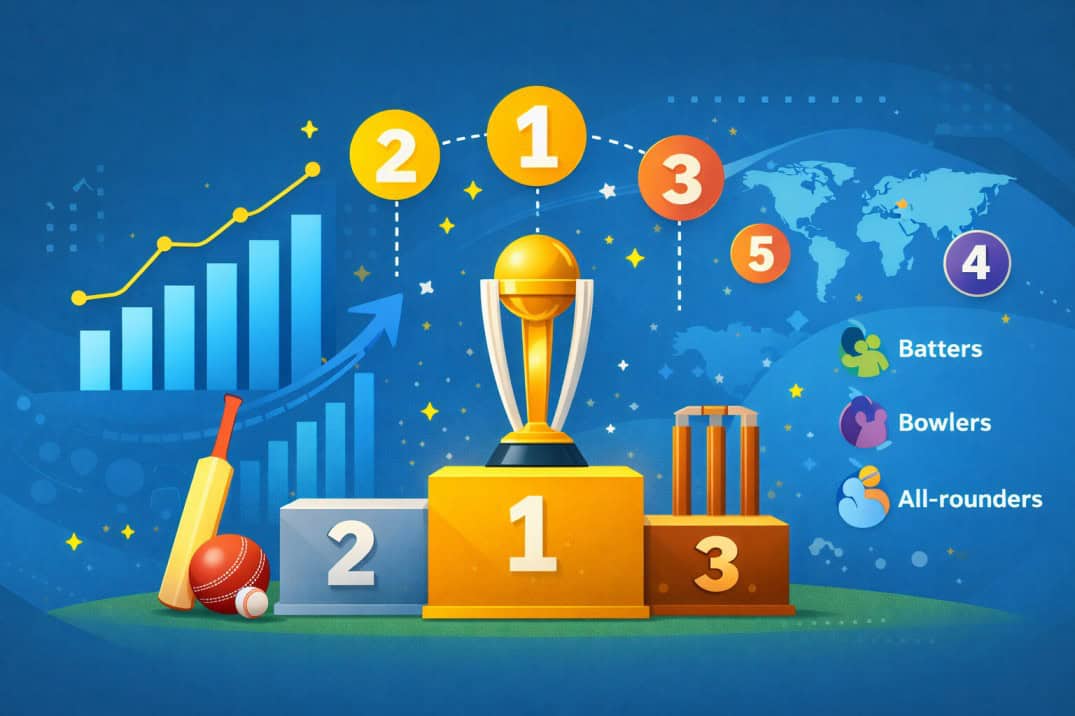
Cricket’s official team and player rankings are a cornerstone of international cricket analysis. Whether you’re a fan trying to follow World Cups, or a commentator breaking down a series, ICC rankings help answer one key question: who is performing best right now? Unlike single-tournament points tables, these rankings measure consistency, strength of opposition and long-term performance across Test, ODI and T20I cricket — making them trusted by fans, teams, selectors and media alike.
What Are ICC Rankings?
ICC rankings are an official metric system maintained by the International Cricket Council. They rank:
- Teams (Test, ODI, T20I)
- Players (batters, bowlers and all-rounders in each format)
This system allows cricket lovers to objectively compare performances over time, across formats and against different quality of opponents.
Types of ICC Rankings
🔹 ICC Team Rankings
ICC team rankings show where international sides stand in Test, ODI and T20I cricket based on recent match results and historical consistency.
For example, as of early 2026:
- No. 1 Test Team: Australia
- No. 1 ODI Team: India
- No. 1 T20I Team: India
These rankings reflect performance over a cycle of matches where recent results are weighted more heavily than older ones.
🔹 ICC Player Rankings
Individual player rankings are split into:
- Batting Rankings
- Bowling Rankings
- All-rounder Rankings
Each player earns rating points based on match performances — runs scored, wickets taken and broader match impact. Quality of opposition and match pressure are part of the calculation.
For instance:
- Top Test bowler: Jasprit Bumrah
- Top Test batter: Joe Root
These positions change with performance and are updated regularly.
How ICC Team Rankings Are Calculated
Team rankings are calculated from a points accumulation system that uses:
- Results from matches over the last 3–4 years
- Greater weight for recent performances
- Series results, win/loss outcomes, and match context
The formula averages total points by the number of matches played, producing a rating score that determines position.
For example, even if a team finishes a series with only narrow wins, the points they earn will influence their rating proportionally, rewarding consistency over time.
How ICC Player Rankings Work
Player rankings are built from rating points, calculated differently for each format:
- Batters gain points for runs scored, strike rate impact, match context and quality of bowling faced
- Bowlers earn points for wickets, economy, match situation and opposition quality
- All-rounders combine batting and bowling impact
Higher points reflect stronger, more consistent contributions over multiple matches. Recent performances count more than older ones.
What Are Rating Points in ICC Rankings?
A player or team’s ranking is not just their position — it’s the result of rating points, which show the strength gap between players or teams. Two players might be ranked close together, yet their point difference might be significant if one has consistently dominated opposition.
How Often ICC Rankings Are Updated
ICC rankings are updated weekly based on latest results, with Test updates sometimes tied to series conclusions, and ODI/T20I updates following individual matches.
This regular update schedule ensures rankings reflect up-to-date performances, rewarding players and teams for recent success.
Why ICC Rankings Are Important
ICC rankings matter because:
- They influence tournament seedings and fixtures
- They show long-term consistency, not just one series
- They help fans compare players across different eras
Being ranked No. 1 highlights a player or team as the current benchmark at their sport’s highest level.
Limitations of ICC Rankings
While ranking systems are useful, they have limitations:
- They may not reflect short-term hot streaks immediately
- Injury layoffs can drop a player’s ranking unfairly
- Cross-format comparison isn’t direct (Test vs T20I vs ODI)
Despite these limitations, ICC rankings remain the most credible objective measure in international cricket.
ICC No. 1 Ranking – Why It’s Special
Reaching No. 1 means a player or team has shown superior performance across matches, conditions and opposition. Many legends of the game have held top spots, cementing their legacy.
In 2026, for example:
- Test Team No. 1: Australia
- ODI Team No. 1: India
- T20I Team No. 1: India
At individual levels, the batting and bowling tables also reflect contemporary dominance, with players like Joe Root and Jasprit Bumrah holding top positions.
Top ICC Rankings in 2026
🏆 Team Rankings (Jan 2026)
| Format | No. 1 Team | Rating |
| Test | Australia | 128 |
| ODI | India | 119 |
| T20I | India | 273 |
🧑 Top Player Rankings — Example
Top Batting (All Formats)
| Category | Player | Country |
| Test Batting | Joe Root | England |
| ODI Batting | Daryl Mitchell | New Zealand |
| T20I Batting | (ranking not fully public, varies weekly) | — |
Top Bowling (All Formats)
| Category | Player | Country |
| Test Bowling | Jasprit Bumrah | India |
| ODI Bowling | Jasprit Bumrah | India |
| (other formats fluctuate weekly) | — | — |
Note: Individual league positions can change weekly; check ICC for latest updates.
Conclusion
ICC rankings measure consistency, quality of opposition and sustained performance over time, making them one of the most trusted tools in world cricket. They help fans, selectors and analysts understand who is truly performing at the highest level — not just who won the latest match.
From team seedings to player legacies, rankings add crucial context to every international cricket season.

Pingback: Top 10 Players to Watch in T20 World Cup 2026 | Full Analysis & Stats